Before you read his books,
test your judgment on four real situations.
Charbel Daniel spent a career learning that some things in front of you are problems. Some are realities. Getting that wrong is what costs organizations, and people, the most. Four real cases from his work. You decide which is which before he does.
Here to book or interview him? Skip to speaking
Someone on your team has been condescending with patients and dismissive with colleagues for years. Leader after leader has said the same thing: that's just who they are. We've tried. It can't be fixed.
Years of leaders had already answered this the way most people just did: treat it as a fixed trait, a permanent condition, something to route around rather than confront.
When Charbel finally sat this person down and told them plainly what their behavior was doing to the people around them, they weren't defensive. They went quiet. "I never knew. Nobody ever told me." The behavior changed within one honest conversation nobody had been willing to have. It happened early in his career, long before Northwood.
From The Problem with Problems, Chapter OneA resident in her eighties wants to keep walking to the dining room on her own. There is a real, measurable chance she falls.
Chase "zero falls" as a target and there's only one way to actually hit it: remove her independence. Confine her to a chair. Lower the bed rails she can't raise herself. That's not a safer resident. That's a person whose life has been narrowed to protect an incident report.
Aging carries risk. That's not a problem to eliminate, it's a condition of living long enough to have this problem at all. What's actually solvable is the environment around her, not the fact that she's growing older inside it.
From The Problem with Problems, Chapter TwoCall volume keeps climbing, and every year it takes a little longer to reach the patient. Every call gets the same response: send an ambulance, and take the patient to the hospital. The obvious answer is more ambulances. The people to staff them do not exist.
The demand was a reality. People needing help is not a malfunction, and about seventy percent of those 911 calls were not emergencies, but the people calling still needed help. More ambulances was never going to be the answer.
The problem was the response. Every call got the same one, whether it was a broken toe or a deadly overdose. Sending the same resource to everyone, and taking everyone to the hospital, was not the solution. Creating alternate pathways was: one responder at the home with a doctor and nurse on a virtual call, and non-critical patients going straight to the waiting room. More than thirty percent of the low acuity calls no longer needed transport, and ambulances were free for the 911 calls that did.
From The Problem with Solutions, Chapter SixArtificial intelligence has arrived, and it keeps developing. The conversation around you is the language of threat: contain it, slow it, stop it, defeat it before it defeats us.
Whatever else is true about AI, it exists. That is not a position on whether it is good. It is a description of the situation, and a thing that exists is not eliminated by being classified as a problem. It is only made harder to think about clearly.
The questions that can be answered are about human decisions: who has access, what they are optimizing for, what guardrails exist and who is accountable for them, and what happens to the people displaced. Those can be worked on. Whether it should have been invented is not one of them. That is grief pretending to be strategy.
From The Problem with Problems, Chapter EighteenYou are surrounded by solutions.
That is the problem.
A problem needs a solution.
A reality needs a response.
Solutions aim at elimination. Responses aim at support. Mistake one for the other and you don't just waste effort, you build a system that fails permanently by its own definition of success.
They respond instead of solve.
They stay instead of manage.
They face instead of fix.
Some things are not meant to be fixed. They are meant to be faced.
Twenty years learning which is which.
Two books on how to tell the difference, and what to do once you can.
International healthcare executive, keynote speaker, and author, a former paramedic, tested in boardrooms on both sides of the border. He's built his career on a distinction most leadership advice skips entirely, and on being honest about what it costs to get it wrong.

- President & CEO, Northwood
- Former COO, MedLife USA
- 16+ years, Medavie Health Services and EMCI
- Chair, Affordable Housing Association of Nova Scotia
- Board, Canadian Home Care Association
- Board, Hereditary Angioedema Canada
Read them in the order he wishes someone had handed them to him.

The Problem with Problems
Publishing November 1, 2026Why we mistake reality for a problem, and what it costs us. The distinction you just tested yourself on, four cases in.
Be the first to know the day it’s out.
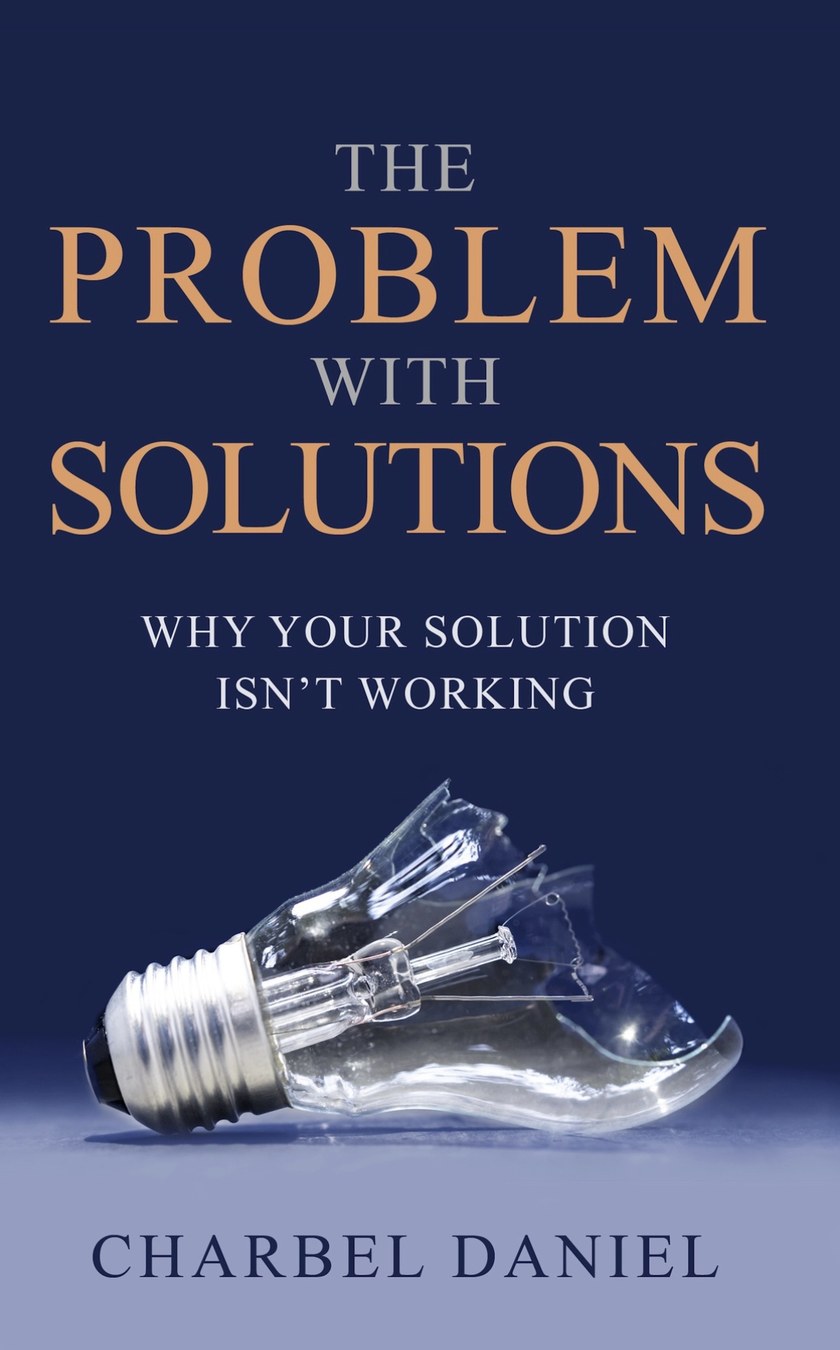
The Problem with Solutions
Available nowOnce you know it's actually a problem, a twelve-step framework, built in the field, for solving it without making things worse.
→ Get the book (opens in a new tab)“Charbel’s wisdom of using the airline industry and applying it to healthcare is a lesson I certainly wish our insurance carriers, clinics, and hospitals would adopt. I love his metaphor of the pendulum and will reflect on his concept BEFORE I enact solutions too fast or too big in the future. Great book.”
Following the run-up to November 1? Follow Charbel on LinkedIn (opens in a new tab)
From The Problem with Problems, Chapter One: “What If This Isn’t the Problem?”
You are surrounded by solutions. That is the problem.
What’s missing is the willingness to stop, before the solving begins, and ask a harder question.
Is this actually a problem?
I learned this for the first time at 3 a.m., in the rain, kneeling beside someone who had just lost the most important person in their world. I was a paramedic. I had been trained for almost everything: cardiac arrest, respiratory failure, trauma, overdose. I knew the protocols.
But there is no protocol for grief.
So I stayed. I held their hand. I breathed with them. Not because there was a clinical reason to, but because in that moment, the most powerful thing I had to offer was not a fix.
It was presence.
Some things cannot be solved. They can only be witnessed.
There is a distinction at the center of this book, and it is one most of us were never taught.
A problem needs a solution. A reality needs a response.
Excerpt from the manuscript. Final published text may differ slightly.